Category: Comforting Thoughts

  • How to Summit Grieving’s Everyday Mountains

    How to Summit Grieving’s Everyday Mountains

    The blog Zen Habits is one of the most popular on the Internet. The following post is an adaptation of a post called A Guide to Reaching Life’s Summits. I thought many of the points and tips in the Zen Habits post apply to the grieving parent’s journey up the mountain of pain we all face each day. The italicized block quotes are from the Zen Habits article, and my grieving parent version is below it.

    Pack light.

    I wish I took this more seriously. Every unnecessary piece of gear complicates things and detracts from the experience. Aside from the bare necessities, things do not make life better. They often cause more stress and keep you from what’s most important. The lighter your pack the better. Life is too short to be burdened with excessive possessions, emotional baggage or regrets. Positive thoughts, relationships and experiences weigh nothing at all. Pile them on and leave the rest behind. They’ll lift you to the top.

    Grieving parents are left with emotional bags to carry on their journey up the grief mountain. So many “should have done this – if only I’d have done that” kind of questions we have. Why did this happen and why didn’t we see it coming and stop it? These emotions don’t help. They create stress. You have to let them go. The truth is we don’t control this life on earth. The ultimate outcome is not in your hands. You have to forgive yourself before you can heal. Lighten up.

    Take one step at a time.

    Any major accomplishment can be broken down into a series of single steps. My pattern for the mountain was 15 steps up, 15 breaths of rest. I did that for 7 hours. If I would have only focused on the very top, frustration would have overcome me. If your summit is too intimidating, break it into smaller steps. Focus on those one by one. Eventually one step will be the one that puts you on top.

    In our computer-based rush around world, we expect results to happen fast – often in just an instant. This is not a trip to the corner store. It’s a journey. A long arduous climb up a mountain. It will take years, and we’ll probably never get to the top of the mountain. Give yourself permission to grieve, to be sad, to accept life has changed and can’t be changed back. One day at a time. One hour at a time.

    Don’t go at it alone.

    When climbing, a partner is a must. For safety, support, camaraderie, motivation and simply to share the journey. You’d be silly (and putting yourself in great danger) to go up alone. Life is meant to be experienced with others. It makes the valleys shallower and the peaks higher. Relationships magnify experiences and help you do things that prove impossible alone. Don’t leave home without your support team.

    Find some help. You need someone to talk to. We’ve found The Compassionate Friends to be a great resource. TCF is made up of other bereaved parents. They’re on the same journey. Some of them have been climbing this mountain for decades. Others are just starting out. They know how you feel and what you’re going through.  Hospice is another good organization that helps the grieving parent. Maybe you have a good church and can get help there. Maybe you need one-on-one care and need to find a professional. Just don’t try to go it alone.

    Listen to the experts.

    Halfway up, a passing guide told us if we couldn’t get to the top by 12:30 at the latest, then to turn back. Chances of late day thunderstorms were too great. As amateurs we would have had no idea. While we all ought to experience our own paths, it’s foolish not to learn from and observe the guidance of experts. Choose your life models wisely and keep them close by on your journey.

    Once again TCF is a good resource. There are also many helpful books.

    Slow down.

    As Yvon Chouinard of Patagonia says, “It’s about how you got there. Not what you’ve accomplished.” Despite what colleagues and competitors may tell you, there is no rush. Rushing on the mountain risks slipping, not acclimating to thinning air, exhaustion and possibly death. In life the biggest risk is that you miss the wonders of everyday experiences in your pursuit to the top. The top is secondary to the process.

    The grieving parents world is a swirling fog of confusion and pain. Slow down. Breath. Take time for quite time. Time to just think and center yourself. A time to find yourself again. This is a marathon not a 40 yard dash. Slow and steady is the best pace.

    Look back and take in the view.

    There’s never any guarantee that you’ll get to the top, but you always have the ability to stop, take in a deep breath, smile and enjoy the view-whether it’s miles of wilderness or two feet of fog. It’s all wonderful. Every moment of life is a new view to appreciate.

    It helps to look back. Remember when the pain was so fresh and new? How you couldn’t get through a day without crying several times? – maybe constantly? Remember how you couldn’t laugh anymore? Then gradually the tears fell less and laughter came back. Maybe you felt guilty. But life does come back. It’s different now, and not better. But gradually it gets better. Look back occasionally and notice.

    Save some energy for the trip down.

    We thought the summit was “just over that peak” half a dozen times before it actually was. Conserve energy. Things will inevitably take longer than expected. Don’t be discouraged. Budget your capital, energy and drive appropriately. Rarely is anything in life an all out sprint. Treat it like a marathon. You may need your reserves when you least expect it.

    It’s said, “A man must know his limits.” Grieving parents have to know their limits too. We all grieve differently. You have to find your way through this.

    Maybe big family gatherings are too much for you at first. Skip a few. Maybe you no longer feel like doing all the Christmas decorating that you did when your child was still here. So don’t do it. Some people we know take trips at Christmas now.

    You won’t “get over it” but you will learn to cope. Just remember you can’t do it all at once. Give yourself time. Take small steps.

    Getting to the top is optional. Getting down is mandatory.

    These are Ed Viesturs’ famous words; the first U.S. man to summit all 14 peaks above 8,000 meters with no bottled oxygen. The summit will be there tomorrow and likely so will yours. If more planning, a stronger team or more support is required, then save the summit for a time when the payout is safer and more probable. If you are outmatched, know when to turn back, only to return stronger and more savvy tomorrow. Stay objective and don’t let short-term excitement get in the way of long-term fulfillment.

    Failure is a part of the process.

    If we would have started our climb the week before, conditions would have been too grave to make it. Be ok with not reaching the summit every time. Falling short is inevitable. You will never learn more than from your failures…at anything. Embrace them.

    A daunting summit is nothing more than a challenge. A challenge is simply an opportunity in disguise. You won’t summit every one you come across, but you will become a better person with each attempt.

    There will always be another mountain. You are not meant to conquer them all. Past summits are simply preparing you for the next. With the right strategy, you’ll put the top within reach. When your summit arrives, you will be ready.

    “It is not the mountains we conquer but ourselves.” ~Sir Edmund Hillary

    Grieving isn’t pretty. There will be good days and bad. Lot’s of bad days. Feeling OK one day and completely down the next doesn’t mean you’ve failed. It’s OK to be sad, to miss your kid so bad you don’t think you can go on. You can go on. Live through the bad times, remember the good ones and keep taking one step forward.

    Original article:
    http://zenhabits.net/summit-mountains/

     

  • Helping a Grieving Parent

    Helping a Grieving Parent

    As my shift at work was winding down that Thursday evening, I was thinking about how I would spend the vacation time I had scheduled for the next day. I was taking off on Friday to have a long weekend. My wife Debbie and I were planning to celebrate our wedding anniversary over the weekend, though our actual anniversary date had been on Wednesday. Then I got ”the call.

    It was that call all parents fear most. The one from the coroner to tell me our youngest son Richard was dead.

    Our lives changed forever in that instant.

    Instead of celebrating our anniversary we planned a funeral and went shopping for a casket, flowers and a grave plot.

    It’s now been over a year since Richard’s death. We spend a lot of time thinking back on those early days. It was all such a foggy blur. What helped us in that time? What helps now? What can you do for a grieving parent? Here are some of the things that cut through the fog and into my memory – things that made a difference.

    Give Your Time

    There is an amazing amount of planning and activity involved in having a funeral.  We had a memorial service the day before Richard’s funeral and the actual funeral service to plan.There are just so many details. Can you take on some of that work?

    • Richard’s funeral was in church. There were a lot of readings and songs that we needed to pick for the service. My sister took on the music planning role for us. It was a relief to be able to just hand that off to her.
    • One of the services offered by the funeral home we used was making a montage of pictures of Richard. This was a chance to show everyone at the memorial service Richard’s life in pictures. We had to supply the funeral home with 30 – 35 images to use. Our daughter Sarah,Hannah and Shelby two of Richard’s closest cousins, and his girl friend Ivy sat in our TV room floor going through albums and boxes of pictures. They went though hundreds of pictures. While they sorted photos they also told a lot of “Richard stories”. As hard as it is to imagine, they helped us smile, as we remembered how much fun he’d been.
    • My siblings, nephew, and nieces showed up at our house with lawn mowers and other tools and went to work in our yard mowing grass. They also cut up some broken tree limbs from a recent storm. Truth is I didn’t care if the grass was knee high at that time. But they were doing anything they could just to let us know how much they cared about Richard and us. That will always mean a lot to us.

    Give Your Talent

    Putting your own talent and personality into your gift will help it stand out in someone’s memory.

    • Gifts of food are welcome in those confusing and busy days following the death of a child. We got many, both at home and at the funeral home for the memorial service. Visitors at the memorial service were our guests a food gifts helped us feed them and make them comfortable. Of all the gifts of food, only one stands out in my mind now. Susan from our church is an artist. Rather than go to the local store and get an off the self fruit tray, she bought a large basket. She filled the basket with a large assortment of fruit, all arranged in a very striking design. It was a work of art. It was almost too pretty to eat – but it went quickly as soon as the first piece of fruit was taken from the basket.
    • I don’t remember many details from Richard’s funeral Mass. In all the blur of pain and disbelief one thing made it past the fog. The choir sang the song “In His Time.” The service was on a Monday morning – a work day, yet there were more people in the choir section that we usually see on Sundays. The verses of the song were sung solo by Chris, a regular member of the choir and Susan, the wife of the choir director, not normally a part of the choir. Neither of these two had ever sung solo before. But they stepped out of their comfort zone to do something special for us. It was beautiful. Remembering this act of compassion still chokes me up today. Is there a talent you could share with someone grieving? Can you go beyond your normal limits to let someone know you care?

    Memorials

    Parents that have lost a child don’t want them forgotten. Memorial items are important.

    • As a birthday gift for her mom, our daughter Sarah made what we call “The Richard Book.” This is a beautiful hard cover book with glossy pages of various Bible verses, remembrances and pictures of Richard. The text of the sermon Father Bill gave at Richard’s funeral and a letter I wrote for his memorial service were printed there. She spent a lot of time and thought picking the content and arranging it. She had the book made at Shutterfly.com, an online photo printing company. I’m sure other online companies offer custom made books too.
    • A nice photo montage, printed and framed would also be a great item. We have a huge one that was made by Memory Lane Montages. They partnered with our funeral home and created a masterpiece montage in less than a day. We had to have a closed casket, so this was really helpful for us and let us show our visitors what our son was all about. You can order from their website, no funeral home needed.
    • My coworker Eric called me off to the side one day at the plant. He handed me a big white box. Inside was an ornate Celtic cross (pictured above) that he had cut on the scroll saw. It was mounted on a plaque. On the back was a copy of the remembrance card from the funeral and Richard’s picture. It is hanging on the wall beside the big photo montage we had made.
    • Several of my aunts and uncles got together and bought us a nice granite bench to place in the cemetery. It has the family name cut in the back. Richard’s grave is close to my mom’s grave. We also have plots there. The bench is under a tree next to our families graves. It’s a nice place to sit when visiting. I’ve sat there and had lunch with Richard. The name on the back is visible from the road, so it helps people find our family plots. It’s a gift that will last for generations.

    Other Ideas

    There are other things you can do that will mean a lot to a bereaved parent.

    • Richard was a member of our church youth group all through high school. Kids from the group got together their “Richard stories” and pictures from some of their times together and put them into a notebook for us.
    • Remember with them. The important life dates – birth date, death date – are really hard times for grieving parents. Can you remember these dates? Send a note letting the parents know you’re thinking about them. Maybe share something you remember about their kid. They’ll never forget their child, but it will give them comfort knowing you haven’t forgotten either and you still care. This website has ideas and suggestions on how to write a heartfelt card or note.
    • Give them a call from time to time, let them know you’re thinking about them.

    Grieving for a lost child is a very long and difficult journey. It will take years. Maybe the best help is to just be there to walk that path with them over time.

    You may feel nothing you say or do can help. There isn’t anything you can do to take away the pain. But you can make dealing with the pain a little less tough. Something as simple as a hug and genuine “I’m so sorry”, maybe a shared tear really do make a difference.

  • Let’s Just Get To The Bottom Of This Hill

    Let’s Just Get To The Bottom Of This Hill

    I read many blogs that deal with Internet Marketing.  I find the subject interesting. One of my favorites is a blog called Psychotactics by Sean D’Sousa.

    In his latest newsletter Sean wasn’t talking to grieving parents, but he could have been.

    Imagine thirty thousand menacing obstacles in your path to success.
    You’re dehydrated. Hungry as hell. And wobbling like an Irishman on
    too much Guinness. Your eyes hurt, your head throbs and your will
    is all but broken. You’re not even sure you want to go on.

    Isn’t that how you’ve felt?

    I’ve heard so many parents that have lost a child say they no longer want to go on… don’t want to live anymore. In those dark days after our kids died we just can’t see any way we can deal with it.

    As in the character Frodo, in the final episode of the ‘Lord of the
    Rings-The Return of the King.’

    Terror and dismay gleam from Frodo’s big, expressive blue eyes. In
    the distance, he can see his goal. But it seems to him like he’ll
    never get there. He turns to Sam and says in a defeated tone, “Sam,
    it’s the Eye,” referring to the eye of Sauron – the enemy he must
    destroy.

    And Sam turns to Frodo in a soft, encouraging voice and says,
    “Let’s just get to the bottom of this hill, Mr.Frodo.”

    And that’s how it is.

    Just get to the bottom of this hill. Just face this day. Take one step at a time.

    Slowly, ever so slowly, you get above the fog. The darkness lets in some light. The pain becomes less intense.

    The journey isn’t an easy one. The monsters and obstacles will always be there. Face them as they come. One at a time. Take the next step.

    Just get to the bottom of this hill.

  • Watching Football

    Watching Football

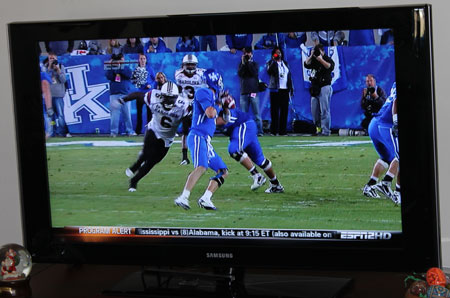
    Football season was always one of my favorite times with Richard – at least during his more adult years.

    While he lived in Lexington he came to most of our pre-game tailgate parties at Commonwealth stadium, when we went to UK games. He didn’t miss much free food. He also liked to come and “discuss” the game.

    We discussed and debated a lot of games. OK, we argued about some of them. But it was always in good fun for us both.

    But anyway, we watched a lot of games together on TV. College games. NFL games. Lot’s of football.

    His room is decorated in a Miami Dolphins theme. He had a Dan Marino bobble-head.

    So this year to celebrate the new season I brought down Richard’s TV set and replaced ours with his. He had a very nice big screen LCD HDTV. According to his cousins – former roommates – Richard was very proud of his TV. It’s much bigger than our little 32″ LCD model. It’s been setting up in his room with all the stacks of his other stuff we brought back from his apartment.

    So now I watch football on Richard’s TV. I’m sure he’s pleased about that. He tried to get us to buy one like it when we got our little set.

    I guess using his TV gives me a little piece of him. A very little piece of him.

    But grieving parents have to take what we can get.

  • Can the Dead Communicate Using Nature?

    Can the Dead Communicate Using Nature?

    I was sitting on my Cracker Barrel rocking chair this morning, sipping coffee and watching the hummingbirds put on a show. We’ve been putting out feeders for them the past several summers. We’ve seen them flying around our feeders and enjoyed watching them. But this year they are different.

    There are a lot of them. They come in bunches. Sometimes one will fly over and hover a few feet away, just watching me. And the chirping. I didn’t know they could do that. I’ve never heard them before. But this year they’re making a ruckus, as they chirp and chatter.

    Since joining the grieving parents fraternity I’ve read lot’s of books. Many of the authors claim they receive signs from their parted loved one via nature.

    These signs usually come from animals. Or butterflies.

    So, is that possible?

    It does seem we’ve had more flying critters the past year.

    As I mow grass I have butterflies hovering around me. Not the little moths I’m used to seeing, but the big pretty ones that I haven’t noticed in our yard in previous summers. And there was that day last fall when we had an entire tree full of them. I’ve NEVER seen that around here before.

    So, is this martin a bringing a message from Richard?

    When I’m mowing down the hill behind the house I have an air force of purple martins diving around me. I’ve never seen them out there before. I don’t have any martin houses up. Yet there they are.

    During our visit with Sarah in Texas in May it seemed everywhere we went, we’d have a big black grackle screeching at us as soon as we got out of the car. It would be sitting on a sign or shopping cart or tree nearby.

    So could these be signs from Richard? Or has the idea been planted in my brain from the stories I’ve read, and now I’m just more observant of the nature that’s been around me all along but I never noticed before? And if Richard can manipulate the animals, why can’t he just come down and talk to me directly?

    As usual, these are questions I have no way to answer.