Tag: Resources

  • Groovy Grieving Music

    Groovy Grieving Music

    Musick has Charms to sooth a savage Breast

    To soften Rocks, or bend a knotted Oak.

    I’ve read, that things inanimate have mov’d,

    And, as with living Souls, have been inform’d,

    By Magick Numbers and persuasive Sound.

    What then am I? Am I more senseless grown

    Than Trees, or Flint? O force of constant Woe!

    ‘Tis not in Harmony to calm my Griefs.

    Anselmo sleeps, and is at Peace; last Night

    The silent Tomb receiv’d the good Old King;

    He and his Sorrows now are safely lodg’d

    Within its cold, but hospitable Bosom.

    Why am not I at Peace?

    – William Congreve, in The Mourning Bride, 1697

    Music has emotional power. A good song can often touch our hearts, and express the feelings we can’t find words for. There seems to be a music genre for just about everything… so why not for grieving?

    Here are some of the songs that have touched me. Some are by grieving parents. Some were written for grieving parents. Some just seem to have a message we need.

    I have to give this quick warning though, grab a fresh box of tissues before you start listening.

    To Where You Are – Josh Groban

    This is one of those with an up lifting message. Maybe we need to hear that, “A breath away’s not far to where you are.”

    Precious Child – Karen Taylor-Good

    I was introduced to this song at our first Compassionate Friends Worldwide Candle Lighting. I doubt it’s an exaggeration to say I’ve listened to it a thousand times since… usually with tears running down my face.

    Here is the story of why the song came to be and some other interesting facts about it.

    You can get a CD single from The Compassionate Friends website. You can download a free mp3 of the song from Karen Taylor-Good’s website. I’ve done both.

    Where Beautiful Souls Go – P. Taylor Reed

    We met P. Taylor Reed at the 2011 Frankfort KY Compassionate Friends Regional Conference. She’s a grieving mom and she wrote this song as a tribute to her son Jeremy.  She performed it for us at the conference.

    You can read her’s and Jeremy’s stories, and purchase a single CD of the song at her website.

    Why by Rascal Flatts

    This is one of my favorite groups. Having a child die is so hard to deal with. Having a child die of suicide seems like it would add even more burden and heartache to an already unbearable event. This song explores that pain.

    As Long As You Love by Cindy Bullens

    Cindy Bullens is an award winning singer/song writer and the bereaved mother of Jessie, a cancer victim at the age of 11 . She did the soundtrack for the documentary Space Between Breaths. I couldn’t find a video with my favorite song from the album, Better Than I’ve Ever Been, but as I write this she’s offering a free mp3 of that song on her official website.

    You can get the soundtrack CD at the Space Between Breaths store. You’ll also find many of these songs on Cindy’s album Somewhere Between Heaven and Earth.

    You can learn more about Jessie and the The Jessie Fund, a charity that helps support children with cancer.

    Tonight I Hold This Candle” by Alan Pedersen

    We’ve met singer/song writer Alan Pedersen at both of the Compassionate Friends of Frankfort regional conferences we’ve attended. He’ll be performing at this year’s conference as well. His daughter Ashley died in a 2001 auto accident.

    He has been referred to as the James Taylor of grieving parent music. He currently has 4 CD’s which you can buy at his store.

    He tours the country with his Angels Across the USA Tour.

    ThePianoGuys with Craig Aven

    ThePianoGuys co-founder Jon Schmidt lost his daughter Annie in November 2016. He tells the story at start of the video and shares the song that helped him deal with his grief. 
  • Beyond Tears by Ellen Mitchell

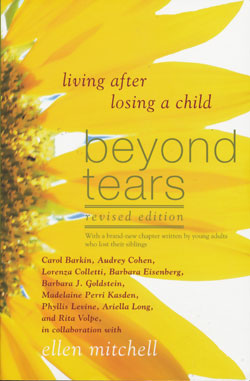
    Beyond Tears by Ellen Mitchell

    There are certain truisms in life. One of them is that it goes against the natural order of things to bury one’s child. However, as bereaved mothers we can no longer believe in natural order. Our comfortable, secure lives, our innocence, all were shattered with the deaths of our children. Now our reality is upside down, inside out and far removed from what we thought it would be.
    Beyond Tears 

    Nine Bereaved Moms Share Their Stories

    Beyond Tears contains the stories of nine bereaved mothers. They have similar backgrounds, each losing a child that was a teen or young adult. They met at Compassionate Friends and became close. They have moved along their grief journey to a point of healing they share in this book.

    They call people that have never experienced the loss of a child “civilians.” I thought that was sort of funny.

    Like probably all of us that have found new friends because we’ve joined the Grieving Parents Club, they express this sentiment:

    We are the closest of fiends. We share the deepest intimacies of our lives. We wish we had never met.

    At the very least we wish we had met under different circumstances.

    The ladies share their thoughts and experiences of losing their children. Chapters deal with the first year, finding help, redefining our existence, coping and dealing with all those special days – birthdays, holidays and anniversaries.

    They also touch on a subject you don’t see much about in a chapter titled, “Intimacy.”

    The anquish of losing a child pollutes every close relationship. It seeks to destroy our ties to our spouses, to our remaining children, to our parents, to cherished friends, to everyone close to us. Each tie is torn to shreds and brutally examined under a high-powered microscope before it can be pieced back together.

    In some cases the pieces will never again mesh and the bond will break. Those relationships that survive will be forever changed because we are changed. We are never the same people we were before the death. The person we become has to learn anew to love and live with those we loved and lived with before, or perhaps to go a seperate way.

    The death becomes a giant black hole in our midst.

    The death of our children is so totally all consuming. “Civilians” as the ladies call them, don’t understand this, even though they try. They become impatient with us and we with them.

    This book, like all the others on grieving I’ve read, illustrate how different we all are. What works for one grieving parent doesn’t for another. What happens quickly for one may take years for someone else.

    This difference in grieving styles is a major stress factor between husband and wife.

    The Ladies Share the Podium

    This book is about the experiences of nine moms, and eight of the ten chapters are about their experiences.

    But they let the dads have one chapter.

    And yes, men are different than women. We’re not as public with feelings. But we have them. We can share them, but I know for me, it doesn’t come naturally.

    I found a blog post by a fellow grieving dad once, where I and several other dads shared our thoughts with one another. We supported each other. But that only lasted for a short time, then we all just sort of faded away.

    All that sharing takes a lot out of you. It requires energy. It’s also a constant reminder of the deep down sadness we feel. There are enough reminders of that.

    Anyway, in chapter nine the dad’s get their say.

    The last chapter is one I’m really glad to see. In chapter ten the “Siblings Speak.” The adult children left behind share their experience.

    This is something I worry about. Our daughter Sarah lost her baby brother when we lost our son. In a way she also lost her parents, because our grief was so consuming.

    She’s an amazing young woman and very detail oriented. We leaned on her a lot to get Richard’s funeral planned. I’m sure that wasn’t fair to her, but she didn’t complain.

    I wonder how this has all been for her. We don’t talk about it. I’m not sure how to even bring it up, and I don’t think she would be real comfortable talking to me about it. But I worry about her.

    I think Beyond Tears is worth reading. I found a lot of stories I can relate to. Through these stories I also learned there is hope. It will always be a struggle, but if we keep moving forward, just one step at a time, we will eventually find a life worth living – different yes, but a life still.

    Beyond Tears: Living After Losing a Child, Revised Edition


  • Words of Wisdom, Hearts of Love

    Words of Wisdom, Hearts of Love

    We just attended our second TCF Frankfort KY Regional Conference, titled “Words of Wisdom, Hearts of Love.” This conference was scheduled for Friday and Saturday at the Capital Plaza Hotel in Frankfort, KY.

    The Best Plans of Mice and Grieving Parents

    We only live 30 minutes from the conference site, but we planned to spend the night at the hotel on Friday. It’s just more relaxing and simpler to just walk down the stairs from our room to the Saturday morning breakfast, rather than getting up early enough to drive in from home. We also get a chance to meet more people attending.

    But we have once again been reminded we aren’t in charge of life.

    My uncle Nick died a week before the conference. The funeral mass was to be on the Saturday morning of the conference. Se we canceled our hotel room and only went to the Friday session.

    Are Conferences a Good Thing?

    I’m still not sure how I feel about these events.

    It’s good to be with other bereaved parents. They know what we’re going through. The folks that have been missing their children for many years and have found a way to rebuild their lives are inspiration. Getting a chance to share experiences and feelings with others in the same boat helps us see we’re not alone, and the things we feel don’t mean we’re crazy.

    But I wonder if going through these events makes us just keep remembering the pain and hold on to it longer. Is it healthy to keep reminding ourselves of how unhappy we are? I’m not sure. I’m leaning toward the benefits are bigger than the risks.

    I also think we need to be there to help other, newer grieving parents if we can.

    The Sessions

    Our Friday session began with a welcome from our chapter leader, Dusty Rhodes. We then had a nice talk by Pat Loder, the current Executive Director of The Compassionate Friends. After a short break we had our first workshop session.

    I went to “The Workplace and Grieving” workshop. The main take-away from this session was employers have no idea how to deal with bereaved parents. I understand this. We’re all different. Employers can’t have a nice step-by-step management plan, so the current plan seems to be just ignore the issue.  They also have no idea how long this problem takes for us to deal with and regain our balance. They don’t like problems that last for years. Newsflash for you – we don’t either.

    The next workshop session didn’t have anything that really jumped out at me, so I picked “Impact of Stillborn & Infant Death.” I chose that because I have a friend and former coworker that had a miscarriage. I wanted to learn more about the issues people like her face. I don’t think our society does a good job of supporting parents in this situation. It was interesting to listen to the other couples there.

    The Slideshow

    Dinner followed the two workshop sessions. We had a speaker during dinner, a former TCF Executive Director whose name I didn’t write down. He gave a good talk. He was a pinch hitter for Gen. Mark Graham who was scheduled to give the dinner time presentation, but military duties called him away. The general made a video for us and we watched that.

    A short session of music followed, featuring Alan Pedersen, P. Taylor Reed and Mitch Carmody.

    Next was the slideshow where slides of our children were shown on two large screens. There were many infants and small children, but it seemed that most of the slides pictured teens and young adults, like Richard. So many bright, beautiful young lives gone too soon.

    Unlike last year I hadn’t heard many sobs or seen many tears in the early sessions, but this changed with the slide show. It’s just so hard to see your kid up there.  My eyes were watery and Debbie was sobbing when Richard’s smiling face hit the screen.

    Candle Lighting

    It began with a few short readings by local chapter members, including Debbie (pictured above). I don’t know how she was able to read after the emotional slideshow session. She’s one brave and strong lady.

    We each processed to the front to light our candles and say “We light this candle in memory of our son Richard Mudd” into the microphone. Of course, other parents/grandparents/siblings said the name of their lost loved one. But you knew that, didn’t you?

    Then we all held our candles up as Alan Pedersen sang.

    There is a powerful feeling in the air during these candle lighting ceremonies. It’s something you can feel. Very intense.

    We took another short break.

    Mitch Carmody was scheduled for a session called “Whispers of Love, Signs from our Children” which sounded interesting but we had to leave.

    We checked out the vendor tables when we were leaving. I think there was a celebrity at the conference. Dennis Apple had some of his books on the table for sale. I didn’t get to meet him, but someone told me they spoke to him, and his son’s picture was in the slideshow, so I think he must have been there. I recommended the book to a couple of people I saw looking at it.

  • Review: life after the death of my son: what I’m learning – by Dennis Apple

    Review: life after the death of my son: what I’m learning – by Dennis Apple

    Several months before his death, Richard was home for the weekend and he was looking at one of my bookcases. On one shelf he spotted a stack of books about seizures and epilepsy.

    He looked at them and asked me, “Why do you have all these?”

    “Because you have that little time bomb in your head, and I thought we should find out about it. Maybe find something that can help.” I told him.

    He just sighed and shook his head at me.

    That’s just how I am. If something interests me, or bothers me, I try to learn as much as I can about it. I buy a lot of books.

    So it should be no surprise I have a large and growing collection of books about grieving and the loss of a child.

    I just finished Dennis Apple’s life after the death of my son: what i’m learning.

    I read this book faster than any other grieving book I’ve owned… except for Good Grief, which is so small it hardly counts.

    Dennis and Buelah Apple’s son Denny died on this day in 1991. I guess this review is my tribute on the 20 year anniversary of his death.

    Dennis Apple kept journals of his experiences after the death of his son. A lot of journals. In this book he shares what he went through in those early years and expands on the lessons learned. He deals candidly with it all… from the pain, the marriage issues, and his doubts about God and religion to finding his way toward healing.

    This is Super Bowl Sunday so one of the comparisons he makes is appropriate on this day. He equates learning to deal with our grief to great athletes learning to play with pain. Play with pain. I really think that’s the goal now. I think it will always be there, so we have to learn to live with it.

    Another part of his story that really hit home for me are the issues of faith. Mr. Apple is a minister and on the pastoral staff at College Church of the Nazarene in Olathe, Kansas. His son’s death made him question God. This had to be really hard for him, as religious life was such a big part of his very core.

    There are so many feel good stories in the readings and songs at church. They tell us about how God is looking over us. That he cares for us. We’re taught that if we follow him to our best ability, he’ll be looking out for us. God has our back.

    Then our kid dies. Denny Apple sounds like he was a great kid. My son Richard wasn’t a saint, but he was a good kid and a fine young man. I was very proud of him. So how could God let something so horrible happen to such good kids?

    In all my years attending Catholic schools I was told God is up there and is all seeing and knowing. He controls everything and has a reason for everything he does. I don’t believe this anymore.

    I still believe there’s a God. I just don’t think God is watching and controlling everything that happens on earth. If he was, how could such pain be allowed?

    I’ve told people that God has a lot of explaining to do. I still feel that way.

    Mr. Apple had to deal with these same doubts at the same time as he was trying to be a minister leading others to God on a daily basis. The conflicts inside had to be overpowering.

    But he made it through all that.

    His story gives us hope. The enormity of the struggles he faced are clearly told, yet he came through it with his soul intact. Like all grieving parents he will never “get over” the loss of his son. He’s just learned to play with pain and he shows there’s hope we can too.

    I highly recommend this book.

    Life After the Death of My Son: What I’m Learning (my Amazon affiliate link)

  • When There Are No Words – A Review

    When There Are No Words – A Review

    It seems most of the books about surviving the loss of a child are written by women.

    This probably isn’t a surprise. Grieving is all about feelings. Most of us guys get queazy when we have to deal with feelings. We just don’t talk about feelings much. We have them, but we would rather you didn’t know about them.

    Dads grieve different.

    In our gift bag at the recent TCF conference in Frankfort, KY there was a book written by a dad.

    Charlie Walton and his wife lost two of their sons in an accident. He shares his experiences in his book When There Are No Words.

    It’s interesting, entertaining and short. I read it in a couple of nights.

    I’ve had similar experiences. Mostly.

    His story of standing in the shower on the night of his son’s death, trying unsuccessfully to cry was one of those.

    I found out about Richard while I was at work. My conversation with the coroner was strangely business like. As I was driving home my body felt like I was crying, but no tears came out.

    When I got home Debbie met me in the driveway. We hugged. All the physical stuff that happens when you cry was going on. I could feel my body shuddering. The right sounds came out. There were no tears. I was wondering what was wrong with me.

    And this continued.

    Later I looked out the front door and saw Debbie pacing on the sidewalk. She was smoking. I went out to join her – with the pacing, not the smoking.

    When Richard was a baby he was a thumb sucker. While Debbie rocked him to sleep, he would work on that thumb and he’d rub her gown between his other thumb and forefinger. He liked the silky feel. Eventually Debbie had to cut up one of her old gowns to give him. It became “his rag.” He had to have it to go to sleep.

    If we were away from home his rag went with us. If it got left behind when we came back, I’d have to make an emergency return trip to fetch his rag. It was the only way to have peace. So eventually we had a spare rag for use when we forgot the one he carried around.

    When I joined Debbie on the sidewalk I noticed she had Richard’s rag in her hand. The sight of that rag – long packed away in the cedar chest for safekeeping until one of Richard’s future children needed it – broke the damn. Tears flowed.

    Another of Charlie’s experiences that hit home was the guilt thing.

    Dad’s are supposed to be the protectors. At least that’s what we think. When our kids die, it seems pretty obvious we didn’t protect so well. It was a big issue then and it still is today. Working on it.

    During the holiday seasons, Charlie and his wife get out of town. They don’t want to be around the family.

    This hasn’t been our approach.

    Our family get togethers still give us comfort. Not having Richard there is tough. There’s no doubt about that. But we’d still be missing him if we didn’t go to the family gatherings. Not attending family events to avoid missing him would just spotlight his absence.

    At least that’s how I feel about it.

    When There Are No Words. is a good book. It’s worth reading.

    Resource Links:

    Get the book at Amazon.