Category: Books

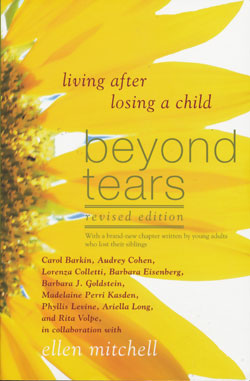
  • Beyond Tears by Ellen Mitchell

    Beyond Tears by Ellen Mitchell

    There are certain truisms in life. One of them is that it goes against the natural order of things to bury one’s child. However, as bereaved mothers we can no longer believe in natural order. Our comfortable, secure lives, our innocence, all were shattered with the deaths of our children. Now our reality is upside down, inside out and far removed from what we thought it would be.
    Beyond Tears 

    Nine Bereaved Moms Share Their Stories

    Beyond Tears contains the stories of nine bereaved mothers. They have similar backgrounds, each losing a child that was a teen or young adult. They met at Compassionate Friends and became close. They have moved along their grief journey to a point of healing they share in this book.

    They call people that have never experienced the loss of a child “civilians.” I thought that was sort of funny.

    Like probably all of us that have found new friends because we’ve joined the Grieving Parents Club, they express this sentiment:

    We are the closest of fiends. We share the deepest intimacies of our lives. We wish we had never met.

    At the very least we wish we had met under different circumstances.

    The ladies share their thoughts and experiences of losing their children. Chapters deal with the first year, finding help, redefining our existence, coping and dealing with all those special days – birthdays, holidays and anniversaries.

    They also touch on a subject you don’t see much about in a chapter titled, “Intimacy.”

    The anquish of losing a child pollutes every close relationship. It seeks to destroy our ties to our spouses, to our remaining children, to our parents, to cherished friends, to everyone close to us. Each tie is torn to shreds and brutally examined under a high-powered microscope before it can be pieced back together.

    In some cases the pieces will never again mesh and the bond will break. Those relationships that survive will be forever changed because we are changed. We are never the same people we were before the death. The person we become has to learn anew to love and live with those we loved and lived with before, or perhaps to go a seperate way.

    The death becomes a giant black hole in our midst.

    The death of our children is so totally all consuming. “Civilians” as the ladies call them, don’t understand this, even though they try. They become impatient with us and we with them.

    This book, like all the others on grieving I’ve read, illustrate how different we all are. What works for one grieving parent doesn’t for another. What happens quickly for one may take years for someone else.

    This difference in grieving styles is a major stress factor between husband and wife.

    The Ladies Share the Podium

    This book is about the experiences of nine moms, and eight of the ten chapters are about their experiences.

    But they let the dads have one chapter.

    And yes, men are different than women. We’re not as public with feelings. But we have them. We can share them, but I know for me, it doesn’t come naturally.

    I found a blog post by a fellow grieving dad once, where I and several other dads shared our thoughts with one another. We supported each other. But that only lasted for a short time, then we all just sort of faded away.

    All that sharing takes a lot out of you. It requires energy. It’s also a constant reminder of the deep down sadness we feel. There are enough reminders of that.

    Anyway, in chapter nine the dad’s get their say.

    The last chapter is one I’m really glad to see. In chapter ten the “Siblings Speak.” The adult children left behind share their experience.

    This is something I worry about. Our daughter Sarah lost her baby brother when we lost our son. In a way she also lost her parents, because our grief was so consuming.

    She’s an amazing young woman and very detail oriented. We leaned on her a lot to get Richard’s funeral planned. I’m sure that wasn’t fair to her, but she didn’t complain.

    I wonder how this has all been for her. We don’t talk about it. I’m not sure how to even bring it up, and I don’t think she would be real comfortable talking to me about it. But I worry about her.

    I think Beyond Tears is worth reading. I found a lot of stories I can relate to. Through these stories I also learned there is hope. It will always be a struggle, but if we keep moving forward, just one step at a time, we will eventually find a life worth living – different yes, but a life still.

    Beyond Tears: Living After Losing a Child, Revised Edition


  • Heaven Is For Real – Book Review

    Heaven Is For Real – Book Review

    Heaven is real.

    Can there be more important or beautiful words that any grieving parents could hear?

    Yeah, there could be better words. “Honey, wake up! You’re having a nightmare,” or “There’s been a big mistake, your son isn’t dead, he’s just been in the witness protection program. But it’s all OK now, so he can come back into your life again,” come to mind.

    But it’s pretty clear those words aren’t going to be played sweetly to our ears. Learning that heaven really exists is our greatest source of hope.

    Todd Burpo says he has proof, Heaven is real.

    Heaven is for Real: A Little Boy’s Astounding Story of His Trip to Heaven and Back is his book. He shares the story of his 4 year old son Colton’s trip to heaven.

    The early parts of this book were hard for me to read. Colton was in the Intensive Care Unit. Been there, done that, and don’t want the damned t-shirt. It brought back a lot of hard memories. It was intensely stressful – I think that’s where the “Intensive” part of the name comes from.

    Like Colton, Richard recovered and came home from the hospital. Unfortunately Richard also came home with scar tissue in his brain that would cause him to have seizures and ultimately kill him.

    Colton was touch-and-go, the doctors didn’t have much hope for him.

    But Colton made a miraculous recovery. He also came home from the hospital. He came home with stories about Heaven.

    Some of the things in this book will make the hair stand up on the back of your neck. For example, Colton was able to tell his parents things they were doing while he was out of it and in surgery. He couldn’t have possibly known what they were doing, each in a separate room and not with Colton. It gets your attention.

    Much of this story seems too perfect. The author, a pastor at Crossroads Wesleyan Church in Imperial, Nebraska, takes every detail of Colton’s story and matchs it perfectly with Bible scripture. It just seems too pat and lines up so well it’s hard to believe. Mr. Burpo could say anything he wants in his book. It just might be all made up.

    But it might also all be real.

    Debbie and I were talking about this. She made the comment,

    “If they had listened to the prophets back in Biblical times, we wouldn’t have all the problems we do now.”  She thinks we need to listen to the prophets God sends to us today. And this little boy just may be one of those prophets.

    You can read the book and come to your own opinion.

  • Review: life after the death of my son: what I’m learning – by Dennis Apple

    Review: life after the death of my son: what I’m learning – by Dennis Apple

    Several months before his death, Richard was home for the weekend and he was looking at one of my bookcases. On one shelf he spotted a stack of books about seizures and epilepsy.

    He looked at them and asked me, “Why do you have all these?”

    “Because you have that little time bomb in your head, and I thought we should find out about it. Maybe find something that can help.” I told him.

    He just sighed and shook his head at me.

    That’s just how I am. If something interests me, or bothers me, I try to learn as much as I can about it. I buy a lot of books.

    So it should be no surprise I have a large and growing collection of books about grieving and the loss of a child.

    I just finished Dennis Apple’s life after the death of my son: what i’m learning.

    I read this book faster than any other grieving book I’ve owned… except for Good Grief, which is so small it hardly counts.

    Dennis and Buelah Apple’s son Denny died on this day in 1991. I guess this review is my tribute on the 20 year anniversary of his death.

    Dennis Apple kept journals of his experiences after the death of his son. A lot of journals. In this book he shares what he went through in those early years and expands on the lessons learned. He deals candidly with it all… from the pain, the marriage issues, and his doubts about God and religion to finding his way toward healing.

    This is Super Bowl Sunday so one of the comparisons he makes is appropriate on this day. He equates learning to deal with our grief to great athletes learning to play with pain. Play with pain. I really think that’s the goal now. I think it will always be there, so we have to learn to live with it.

    Another part of his story that really hit home for me are the issues of faith. Mr. Apple is a minister and on the pastoral staff at College Church of the Nazarene in Olathe, Kansas. His son’s death made him question God. This had to be really hard for him, as religious life was such a big part of his very core.

    There are so many feel good stories in the readings and songs at church. They tell us about how God is looking over us. That he cares for us. We’re taught that if we follow him to our best ability, he’ll be looking out for us. God has our back.

    Then our kid dies. Denny Apple sounds like he was a great kid. My son Richard wasn’t a saint, but he was a good kid and a fine young man. I was very proud of him. So how could God let something so horrible happen to such good kids?

    In all my years attending Catholic schools I was told God is up there and is all seeing and knowing. He controls everything and has a reason for everything he does. I don’t believe this anymore.

    I still believe there’s a God. I just don’t think God is watching and controlling everything that happens on earth. If he was, how could such pain be allowed?

    I’ve told people that God has a lot of explaining to do. I still feel that way.

    Mr. Apple had to deal with these same doubts at the same time as he was trying to be a minister leading others to God on a daily basis. The conflicts inside had to be overpowering.

    But he made it through all that.

    His story gives us hope. The enormity of the struggles he faced are clearly told, yet he came through it with his soul intact. Like all grieving parents he will never “get over” the loss of his son. He’s just learned to play with pain and he shows there’s hope we can too.

    I highly recommend this book.

    Life After the Death of My Son: What I’m Learning (my Amazon affiliate link)

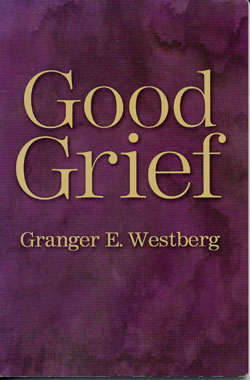
  • Good Grief by Granger Westberg

    Good Grief by Granger Westberg

    This little 64 page book is the first book about grief I added to my library.

    Joanne, wife of Deacon John Shoulta from our church handed it to me at the funeral home during the visitation. It’s so small it fit in the inside pocket of my suit jacket.

    I think I read it that night. The pages are small, so it only took about an hour.

    This little book and I got off to a bit of a rocky start. In the introduction the author starts talking about grieving over stuff like having the boss you love be replaced by one you don’t like.

    Or grieving over moving away to a new place and leaving friends behind. My kid is in a box and you’re worried about having to make new friends?

    Is that why it’s called Good Grief – because that’s what people say when they read it?

    OK I’ll be fair. The author wasn’t equating moving to a new neighborhood to having your child die. He is just pointing out we deal with grief in some form often. Much more than we realize – it’s “as natural as breathing”. Westberg says dealing with these little griefs points us in the way we’ll deal with a big one.

    Like a lot of books dealing with grief this one lists stages of grief –  ten of them in this case:

    1. We are in a state of shock.
    2. We express emotion.
    3. We feel depressed and very lonely.
    4. We may experience physical symptoms of distress.
    5. We may become panicky.
    6. We feel a sense of guilt about the loss.
    7. We are filled with anger and resentment.
    8. We resist returning.
    9. Gradually hope comes through.
    10. We struggle to affirm reality.

    The author goes on to cover each in a separate chapter.

    I don’t think I’ve ever felt lonely. Just the opposite. I usually just want to be by myself – and can’t get people to leave me alone. This is especially true at work. Just way too much “teamwork” and too many meetings there.

    I also don’t remember ever feeling panicky. Richard is dead. It’s much too late to panic now. I just feel sad.

    So all these stages don’t apply to everyone. We’re all different. But it all still fits. And it was helpful to read at least a framework for what was ahead for us.

    This may have been one of the best choices to read in those fog shrouded early days. I don’t think I could have made it through a long detailed book. I needed to know about the grief we were now forced to live. I was determined to live this grief, not hide from it. Good Grief was a valuable primer on the subject. You just have to keep an open mind on what grief is.

    Amazon Link

    Good Grief: A Constructive Approach to the Problem of Loss

  • Grieving Dad’s Project

    Grieving Dad’s Project

    I stumbled upon this site today.

    Geared toward grieving dads. Kelley Farley is a bereaved father that’s had two children die. He has decided to write a book to help grieving fathers.

    His website tells his story and leads to a survey where you can tell yours.

    He hopes to get enough stories about dad’s that have traveled the grief journey to put together a resource for other grieving dad’s searching for help and hope.

    Resource Links:

    The project website: http://www.grievingdads.com/

    Follow him on Twitter: http://twitter.com/GrievingDads