Author: Joe Mudd

  • The Last Jolly Rancher

    The Last Jolly Rancher

    Richard was a fan of Jolly Ranchers.

    In case you don’t know,  Jolly Ranchers are rectangular blocks of fruit flavored hard candy. Each Jolly Rancher comes individually wrapped in cellophane wrappers.

    He had lots of them in his apartment. There were a couple of containers of them on his desk. There was a cup full on an end table. There was also a huge unopened bag of them in one of his kitchen cabinets.

    Because of the strong chemicals used to fumigate Richard’s apartment after his death, I tossed out all the candy he had in open containers. I didn’t trust the cellophane wraps that were just twisted closed on the ends to keep the chemical fog away from the candy.

    But I was sure the big unopened bag was OK and I brought it home when I cleaned out his apartment.

    Over the past two and a half years I’ve eaten Richard’s Jolly Ranchers. I would think of him with each piece. It was like sharing a little bit of his life again.

    We also “gave some to Richard” at candy giving times by tossing them on his grave – with the wrappers removed of course.

    Today we went to the cemetery and did a bit of Halloween decorating at Richard’s grave. Debbie tossed out some candy for Richard.

    In that candy she tossed on his grave was the last of Richard’s Jolly Ranchers. There were two left and she gave them to Richard.

    They were his of course, and it’s only right he gets to finish them off. The wrappers were getting hard to peel away from the candy and it was time to do something with them.

    But it seems along with the last chunk of the candy he loved and bought with his own money, another piece of my kid is gone.

    Yes, that’s pretty silly when you really think about it. But then, having to bury one of your kids is pretty silly too.

    Happy Halloween kid, I hope you enjoy the candy.

  • Back To Court

    Back To Court

    I’ve recently been trying to close Richard’s checking account. I know I should have done this a long time ago, but you just can’t rush some things. I would have just kept on waiting but Chase forced me into it because they started charging a “service fee” on the account. In a couple of more months the account would have been gone.

    I had to make 3 visits to the bank for this, and it finally looked like things were heading to completion and they were going to issue a check and close the account. The problem is I had to deal with a different people each time I was there. The lady I talked to the last time made some calls to the front office.

    As proof of my right to claim Richard’s account I brought the court order to Dispense With Administration. This order says what belonged to Richard now belongs to me.

    While I was sitting there the people on the phone with the local banker lady told her I also need to provide a certified copy of the death certificate. The fact that you only administer the estate of a dead person, and therefore an order to dispense with administration means the person in question, in this case Richard, has passed away.

    So I left the bank to go home for a copy of the death certificate.

    Just after I walked in the door at home, the phone rang. It was the lady from the bank. The front office told her that my order to dispense didn’t apply to them because Richard’s checking account wasn’t listed on the order.

    Perhaps I should do a quick review of the legal process involved here. Oh, by the way, I’m not an attorney, I don’t play one on TV, and if you need legal advice of any kind please seek real legal council.

    The Legal Side of the Death of Your Child

    When someone dies their estate must be dealt with. This involves taking care of any debts they left behind and distributing their assets to the proper people. This is handled in one of two ways:

    1. If the person had a will, his wishes as spelled out in the will must be executed. This means someone must be appointed to be the executor of the estate.
    2. If there is no will, termed dying intestate, the estate must be administered using guidelines provided by the state. The person appointed to represent the estate is an administrator.

    Richard didn’t have a will.

    Early on after his death, we went to court with the help of our attorney, and I was appointed to be the administrator of Richard’s estate. The idea of Richard having an estate still seems totally bizarre to me.

    After being declared the administrator I next had to provide an inventory of Richard’s assets and also a list of any known claims against his property – his debts. Next his death is published with a call for anyone with claims against the estate to come forward. There is a six month period in Kentucky for claims against the estate to be made.

    In our case Richard was a single college kid. He had no wife or children. Because he had no will and no dependents, in Kentucky Richard’s parents, us, would become his heirs and would take ownership of anything left after his creditors were paid.

    I don’t know if  it works this way anywhere else, but in Kentucky there are “preferred creditors.” They get paid first. At the top of the preferred creditor list is the funeral provider. Because I paid for his funeral, I was at the top of that preferred creditor list. Richard’s estate had to reimburse me for the cost of his funeral before anyone else could be paid.

    The property he left behind totalled less than $2000. The funeral cost dwarfed this amount. It was many times that amount.

    This meant his estate wasn’t big enough to cover the funeral expenses. It also meant no other creditors could be paid. The credit card companies he owed money to were just out of luck.  It aslo meant waiting the state required six months would be a waste of time.

    Our lawyer went to court with me and we asked the court to speed the process up. This is called Dispensing With Administration. The court acknowledged my positon as the lone preferred creditor, and that no other creditor would be paid. The inventory of the estate, both assets and liabilities were listed and the court declared Richard’s property to now be my property.

    But I forgot to list his checking account in the inventory.

    If common sense mattered in the world, this wouldn’t make any difference. We can only wish for that, because there is very little common sense in the world and none in the banking industry.

    It should be pretty easy to figure out that adding the just over $100 value of Richard’s checking account to the asset inventory would still not bring the total remotely close to the $14,000 cost of his funeral, and the order to Dispense with Administration would still apply. It should also be obvious that after two and a half years, the six month claim period for creditors to come forward was long past, and the estate would have been transferred to his heirs a long time ago even without the order to dispense. We are his heirs.

    But Chase wants to be a pain.

    So our attorney is now going back into court to have the Order to Dispense amended to include Richard’s checking account.

    It will take a little longer to close his account. Chase has charged another monthly service charge in this delay period. They’ll get to give it back.


  • Unfinished Business

    Unfinished Business

    Today I’m exhausted.

    I’ve begun the process of taking care of all my unfinished Richard business. It’s a pretty impressive to-do list. There are just so many little things that need to be done, so many loose ends that need tying.

    In the early days after Richard’s death I had a lot of energy to get all the legal and financial things taken care of. I felt like making sure Richard’s money was secured, and his final financial house was in order, was one last thing I could do for my kid.

    But you can’t just go and transfer funds, and close accounts. You need legal documentation that says you have the right to do those things. That’s a good thing, because we don’t want someone to be able to come in and transfer all our money out of our bank accounts without jumping through a whole bunch of hoops.

    But there was a problem. This process all begins with the death certificate. It took three months to get Richard’s death certificate. That’s a long time to wait, and to maintain the desire to force yourself to do emotionally hard tasks.

    It also turns out most financial institutions won’t let you access accounts with only a death certificate. You need court orders that give you authority. This of course takes more time.

    Richard left behind a checking account, a small mutual fund account, a couple of paychecks, a broke down Camero, and assorted credit card bills.

    The credit cards were taken care of as soon as it was legally possible. I had an attorney do that for me. Credit card companies seem to take the news that they won’t be getting any money much better when a lawyer tells them.

    It’s the other items, the assets, that I’m struggling with.

    They’re like little pieces of him left behind. I know it sounds silly, but closing those items out is sort of like he’s dying all over again. At least a little bit.

    He had an automatic draft from his checking account of $50 each month going to his mutual fund. I had to stop that as soon as the death certificate arrived because his checking account balance got too low to make another payment. $50 bucks a month wasn’t much, but it was just an example of Richard’s plans for the future. The future that will never be. But I can still feel his hopes and dreams when I look at his account statements that come to our mail box.

    It’s really hard to let go of those pieces of him.  So, I’ve been putting it off.

    I’ve been forced to deal with it.

    Chase bank has started charging his account a monthly maintenance fee. In a couple of months they’ll have all that’s left in there. I don’t think he’d like that. So I’ve spent the last couple of days dealing with the bank to get his account closed. He had some sort of reward points that I’m having converted to cash. They’re worth nearly $100. It’s taking them a long time to post the funds to his account, so I’m still waiting to close it out.

    The emotional stress of such a simple thing as closing a bank account is exhausting.

    I still have to transfer his mutual fund into my name. I need to do something with his car that’s rotting in our driveway. And I need to have his two final paychecks, that expired before we could get the death certificate, reissued.

    I don’t want to do any of those things. But I guess the time has come.

  • What Does The Soul Know?

    What Does The Soul Know?

    It’s now been two and a quater years since Richard died. It seems like it was just yesterday, and it feels like it’s been a lifetime.

    After all this time, I still often feel like it’s not real… like Richard is still here. I often expect him to walk into the house, and just flash that sheepish grin when he sees our shocked expression. I just don’t feel like he’s really dead.

    Then the tidal wave will wash over me. You know, that tsunami that just overwhelms you when you realize you’ll never see your kid again… at least on this earth. I think that’s my brain talking. My brain has processed Richard’s death and added that piece of data to all the rest it has stored away. And every so often, my brain has to assert itself and point out the facts as it knows them. Richard is dead, and I’m not going to see him again.

    So why do I keep getting this feeling that’s not really true?

    When we think about our feelings we most often talk about them coming from the heart. I know I find myself even clutching my chest when I think about these strong feelings. Like they’re coming from deep within. From my very core.

    I wonder, is this where our soul is?

    Is our soul at our core, at our heart?

    I use the term soul because of my religious faith. But maybe that’s not what you call it. I’m talking about that spiritual part of us, the part that keeps on going when our body stops. The part of us we believe is eternal.

    Does our soul know those other souls are out there, the ones that no longer are tied to a human body? Can it “feel” their presence even when we can’t see them? What does the soul know?

    When I think of Richard, and wonder where he is, even speak out to him, I find myself looking to the sky – to the heavens. Most religions even call that place our souls go “Heaven”. Is that where he is now, out in the sky somewhere?

    Or is he right here still, but just in another dimension – one our physical bodies can’t detect? Maybe Richard is here now, looking over my shoulder as I type.

    We know of at best 4 dimensions: length, width, height and time. That’s all we can tell about with our limited bodies. But physicists believe there are many, many times more dimensions. I read a book called The Black Hole Wars that dealt with the battle of the physicists over these theories. It talked about string theory and it made my head hurt. But these guys are all pretty darn sure there are a bunch of dimensions.

    Maybe one of those dimensions is where the spirit lives. Could be right here on earth, kind of a parallel universe. And maybe our souls know it’s there. It can’t communicate with it in any fashion we understand – except maybe for a few “sensitive” people. But still, our soul has some connection with that place.

    And that’s why deep down inside we know our kids are still with us. Our brains don’t get it.

    But our souls know.

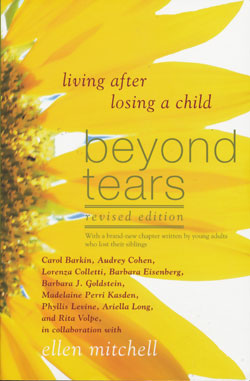
  • Beyond Tears by Ellen Mitchell

    Beyond Tears by Ellen Mitchell

    There are certain truisms in life. One of them is that it goes against the natural order of things to bury one’s child. However, as bereaved mothers we can no longer believe in natural order. Our comfortable, secure lives, our innocence, all were shattered with the deaths of our children. Now our reality is upside down, inside out and far removed from what we thought it would be.
    Beyond Tears 

    Nine Bereaved Moms Share Their Stories

    Beyond Tears contains the stories of nine bereaved mothers. They have similar backgrounds, each losing a child that was a teen or young adult. They met at Compassionate Friends and became close. They have moved along their grief journey to a point of healing they share in this book.

    They call people that have never experienced the loss of a child “civilians.” I thought that was sort of funny.

    Like probably all of us that have found new friends because we’ve joined the Grieving Parents Club, they express this sentiment:

    We are the closest of fiends. We share the deepest intimacies of our lives. We wish we had never met.

    At the very least we wish we had met under different circumstances.

    The ladies share their thoughts and experiences of losing their children. Chapters deal with the first year, finding help, redefining our existence, coping and dealing with all those special days – birthdays, holidays and anniversaries.

    They also touch on a subject you don’t see much about in a chapter titled, “Intimacy.”

    The anquish of losing a child pollutes every close relationship. It seeks to destroy our ties to our spouses, to our remaining children, to our parents, to cherished friends, to everyone close to us. Each tie is torn to shreds and brutally examined under a high-powered microscope before it can be pieced back together.

    In some cases the pieces will never again mesh and the bond will break. Those relationships that survive will be forever changed because we are changed. We are never the same people we were before the death. The person we become has to learn anew to love and live with those we loved and lived with before, or perhaps to go a seperate way.

    The death becomes a giant black hole in our midst.

    The death of our children is so totally all consuming. “Civilians” as the ladies call them, don’t understand this, even though they try. They become impatient with us and we with them.

    This book, like all the others on grieving I’ve read, illustrate how different we all are. What works for one grieving parent doesn’t for another. What happens quickly for one may take years for someone else.

    This difference in grieving styles is a major stress factor between husband and wife.

    The Ladies Share the Podium

    This book is about the experiences of nine moms, and eight of the ten chapters are about their experiences.

    But they let the dads have one chapter.

    And yes, men are different than women. We’re not as public with feelings. But we have them. We can share them, but I know for me, it doesn’t come naturally.

    I found a blog post by a fellow grieving dad once, where I and several other dads shared our thoughts with one another. We supported each other. But that only lasted for a short time, then we all just sort of faded away.

    All that sharing takes a lot out of you. It requires energy. It’s also a constant reminder of the deep down sadness we feel. There are enough reminders of that.

    Anyway, in chapter nine the dad’s get their say.

    The last chapter is one I’m really glad to see. In chapter ten the “Siblings Speak.” The adult children left behind share their experience.

    This is something I worry about. Our daughter Sarah lost her baby brother when we lost our son. In a way she also lost her parents, because our grief was so consuming.

    She’s an amazing young woman and very detail oriented. We leaned on her a lot to get Richard’s funeral planned. I’m sure that wasn’t fair to her, but she didn’t complain.

    I wonder how this has all been for her. We don’t talk about it. I’m not sure how to even bring it up, and I don’t think she would be real comfortable talking to me about it. But I worry about her.

    I think Beyond Tears is worth reading. I found a lot of stories I can relate to. Through these stories I also learned there is hope. It will always be a struggle, but if we keep moving forward, just one step at a time, we will eventually find a life worth living – different yes, but a life still.

    Beyond Tears: Living After Losing a Child, Revised Edition