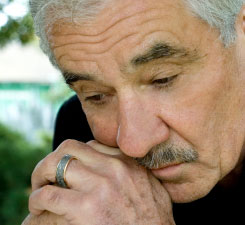
Tag: dads

  • Grieving Dad’s Project

    Grieving Dad’s Project

    I stumbled upon this site today.

    Geared toward grieving dads. Kelley Farley is a bereaved father that’s had two children die. He has decided to write a book to help grieving fathers.

    His website tells his story and leads to a survey where you can tell yours.

    He hopes to get enough stories about dad’s that have traveled the grief journey to put together a resource for other grieving dad’s searching for help and hope.

    Resource Links:

    The project website: http://www.grievingdads.com/

    Follow him on Twitter: http://twitter.com/GrievingDads

  • When There Are No Words – A Review

    When There Are No Words – A Review

    It seems most of the books about surviving the loss of a child are written by women.

    This probably isn’t a surprise. Grieving is all about feelings. Most of us guys get queazy when we have to deal with feelings. We just don’t talk about feelings much. We have them, but we would rather you didn’t know about them.

    Dads grieve different.

    In our gift bag at the recent TCF conference in Frankfort, KY there was a book written by a dad.

    Charlie Walton and his wife lost two of their sons in an accident. He shares his experiences in his book When There Are No Words.

    It’s interesting, entertaining and short. I read it in a couple of nights.

    I’ve had similar experiences. Mostly.

    His story of standing in the shower on the night of his son’s death, trying unsuccessfully to cry was one of those.

    I found out about Richard while I was at work. My conversation with the coroner was strangely business like. As I was driving home my body felt like I was crying, but no tears came out.

    When I got home Debbie met me in the driveway. We hugged. All the physical stuff that happens when you cry was going on. I could feel my body shuddering. The right sounds came out. There were no tears. I was wondering what was wrong with me.

    And this continued.

    Later I looked out the front door and saw Debbie pacing on the sidewalk. She was smoking. I went out to join her – with the pacing, not the smoking.

    When Richard was a baby he was a thumb sucker. While Debbie rocked him to sleep, he would work on that thumb and he’d rub her gown between his other thumb and forefinger. He liked the silky feel. Eventually Debbie had to cut up one of her old gowns to give him. It became “his rag.” He had to have it to go to sleep.

    If we were away from home his rag went with us. If it got left behind when we came back, I’d have to make an emergency return trip to fetch his rag. It was the only way to have peace. So eventually we had a spare rag for use when we forgot the one he carried around.

    When I joined Debbie on the sidewalk I noticed she had Richard’s rag in her hand. The sight of that rag – long packed away in the cedar chest for safekeeping until one of Richard’s future children needed it – broke the damn. Tears flowed.

    Another of Charlie’s experiences that hit home was the guilt thing.

    Dad’s are supposed to be the protectors. At least that’s what we think. When our kids die, it seems pretty obvious we didn’t protect so well. It was a big issue then and it still is today. Working on it.

    During the holiday seasons, Charlie and his wife get out of town. They don’t want to be around the family.

    This hasn’t been our approach.

    Our family get togethers still give us comfort. Not having Richard there is tough. There’s no doubt about that. But we’d still be missing him if we didn’t go to the family gatherings. Not attending family events to avoid missing him would just spotlight his absence.

    At least that’s how I feel about it.

    When There Are No Words. is a good book. It’s worth reading.

    Resource Links:

    Get the book at Amazon.

  • Grieving Dad’s

    Grieving Dad’s

    The following is from We Need Not Walk Alone, the national magazine of The Compassionate Friends.

    The Father’s Grief

    By David Pellegrin
    TCF Honolulu, HI

    At my second meeting of The Compassionate Friends about three years ago, one of the mothers said how nice it was to see a man attending, since “men grieve differently from women.”

    Her remark was no doubt meant to help put me at ease. I hadn’t said a thing so far, and might have been intimidating in my silence. But it caught me off guard. What I was feeling after George’s death was so absolute, so awful, how could it possibly come with any “differences”? Would one grieve differently for an infant than for an adolescent? For a son than for a daughter? Surely, grief was absolute for both mothers and fathers.

    Over time I came to acknowledge the differences the well-meaning mother had in mind:

    • Neither I nor the other men who occasionally attended talked much; the women talked freely.
    • I sensed I was better at compartmentalizing my grief than the mothers, better at keeping a lid on it socially and at work.
    • My male friends seemed less comfortable talking about George, bringing up his name or even looking at his pictures than female friends.
    • I came to see how intensely I felt I had let my son down as his protector, the father’s primary role.

    Shortly after becoming editor of my chapter newsletter, I sent a copy to my friend Jack Knebel in California. Jack and his wife, Linda, had been involved with a Compassionate Friends chapter after the death of their daughter, Hollis. He replied, “It’s good to see that a man is taking an active role in the group.” Then he went on to write movingly about those male- female grieving differences. The rest of his letter,
    which touched me deeply, follows:

    . . . Several years after Hollis died, Linda and I were being trained by Compassionate Friends to be ‘buddies’ for newly bereaved parents. One of the exercises was to list all the unhelpful things that others had said in trying to comfort us, so that we wouldn’t make the same mistakes. The other trainees, all women, made long lists, and did it with enthusiasm. When the lists were read aloud, they nodded knowingly at every entry and eventually hooted and howled with derision at the worst (some of which were pretty bad). When it came my turn, I held up an empty page and said:

    “People may have said such things to me. I just don’t recall.

    “What I do remember is that people tried to tell me how sad they were for us. I remember being told how much they loved Hollis and how much they cared about us. I remember one of my partners hugging me in the halls of my very stiff and proper law firm. I remember men who had never told me anything more personal than their reactions to a Giants’ loss crying at our loss and their fears.

    “You women are used to talking to each other about your emotions and about personal things. I wasn’t and my friends weren’t either. So the fact that we could do so was a great gift, and it wasn’t marred in the slightest by someone’s choice of words.”

    Now, the shell has been broken and I find it easier to talk about my emotions, my hopes and fears, about those things that really are important. And that for me was one of Hollis’ greatest gifts.

    I know that even after George’s death, he is a major part of your life. My guess is that you’re becoming more open to the gifts that he and those who care about you are able to give.

    Yours, with compassion and friendship,
    Jack

    Another difference I notice about how men and women handle grief – women write poetry, men not so much. I’ve looked at a lot of memorial websites put up by other grieving parents. I’ve seen lot’s of poetry. And I think every poem was written by a woman. Newsletters from TCF and Hospice have published poems, all by grieving moms.

    Why is that?

    Well I’m not a poet, and I know it. So you’ll probably never see a poem written by me on here.

    And that’s probably a good thing.