Month: February 2010

  • Lighting Candles at Church

    Lighting Candles at Church

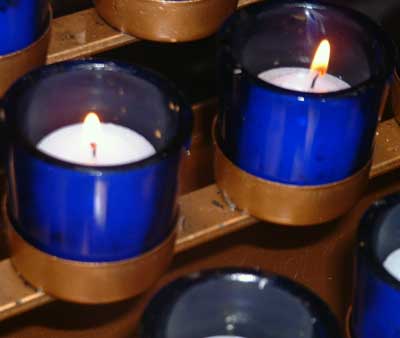
    The Compassionate Friends have an annual candle lighting ceremony and lighting candles is an important ritual in the Catholic Church. I light candles for Richard at least once a week.

    So why do we light candles?

    In lighting candles we see our prayer rising up to heaven. We join our prayer in solidarity with others that have lit candles before us.

    Also in the literature about life after death you see a lot about moving into the light. And in the Bible, Christ says, “I am the light of the world.” So our candles become a symbol of the One Light of Christ.

    In Catholic churches candles are usually placed before statues of saints. In our church the candles are before statues of the Blessed Mother and Joseph. In our faith we ask these saints to intercede on our behalf. With their personal relationships with Christ, we believe their intercession gives our prayer more power.

    While saying prayers for Richard and others I love, I also offer prayers for those souls that don’t have anyone on earth praying for them.

  • Miracles

    Miracles

    Church can be a dangerous place for a grieving parent.

    In his sermon Sunday, Father Bill mentioned some miracles. He started with several taken from the Bible, including the story of Christ raising a little dead girl back to life.

    Father Bill then told us of a local family. One of the boy’s in the family was getting ready for major surgery and was afraid. But he never had the surgery. When the doctors took some pre-op pictures, the mass they were intending to remove was already gone.  It had just vanished.

    And he told us about a local man with some form of cancer and in bad shape. But his illness had suddenly gone into total remission.

    And while listening to this, I looked over at Paula in the choir. Her husband had cancer. I remember when a bunch of us placed our hands on him a prayed for his cure. And his cancer took his life. I wondered if Paula was thinking, “Where was my husband’s miracle?”

    Richard was as loved and prayed for as anyone could be. From everything I knew about him and what others told me about him, he lived a good life. He had faith. Where was his miracle?

    So many questions with no answers.

  • Richard Introduces Us To Ivy – Sort Of

    Richard Introduces Us To Ivy – Sort Of

    Many times Richard and I were told we were just alike. One of our shared quirks was not liking it when someone was watching over our shoulder. We like our privacy.

    When Richard was in his late teens and early twenties he didn’t often share what was going on in his “private life” with us – unless it required money from home. This didn’t bother me much because I knew Richard wasn’t doing anything bad and I understood him.

    In October 2007, Debbie got a call from Richard’s roommate Drew. He was panicked because Richard was having a seizure. She told him to call an ambulance and have Richard taken to the nearest hospital. She called me at work and told me where they were taking him and we met at the hospital – St. Joseph’s.

    He had a massive seizure. The emergency room people had a hard time calming his body down. He had to be put in restraints. They had a tough time getting an IV in him. Every time they tried to insert the needle he’d convulse, his muscles would tense with powerful contractions and the vein would collapse.

    It was a long, tense time, but finally the drugs stopped the seizure activity and Richard slept.

    It seems most people that have seizures come back around as soon as the seizure activity is over. They’re sleepy but alert.

    Not Richard. His seizures were totally consuming. When the seizure was over he was out of it. The doctors and nurses couldn’t get him to respond for hours.

    So we waited.

    The afternoon pressed on into evening as we waited by his bed in the emergency room. As we sat there worrying, a little blond girl walked into the room. She glanced at us, went over to Richard and took his hand. She stood there with his hand in hers, gently stroking it with her other hand.

    I looked at Debbie, she looked at me, both puzzled. Who was this person?

    Finally we said, “Hi, we’re Richard’s parents. Who might you be?”

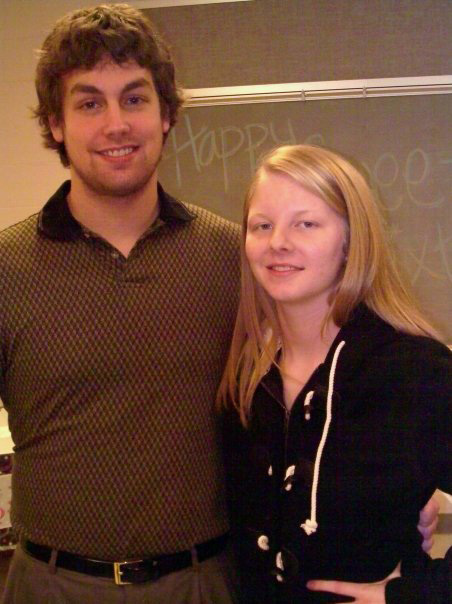
    Her name was Ivy. Turns out she was Richard’s girl friend. And we’d never heard of her before.

    Hell of a way to meet your kid’s girl friend.

    We chatted during the early evening hours. We took her out to eat when it became obvious Richard was going to be out of it for a while.

    She stayed with us for a long time that night. It was a comfort to have her there.

    And when Richard finally woke up in the ICU the next day, having her there kept him from being depressed about having another seizure.

    Ivy made Richard happy for the last couple of years of his life. We like her.

    We just wish he’d have introduced us in a more conventional manner.

    But that was Richard.
  • Grieving Dad’s

    Grieving Dad’s

    The following is from We Need Not Walk Alone, the national magazine of The Compassionate Friends.

    The Father’s Grief

    By David Pellegrin
    TCF Honolulu, HI

    At my second meeting of The Compassionate Friends about three years ago, one of the mothers said how nice it was to see a man attending, since “men grieve differently from women.”

    Her remark was no doubt meant to help put me at ease. I hadn’t said a thing so far, and might have been intimidating in my silence. But it caught me off guard. What I was feeling after George’s death was so absolute, so awful, how could it possibly come with any “differences”? Would one grieve differently for an infant than for an adolescent? For a son than for a daughter? Surely, grief was absolute for both mothers and fathers.

    Over time I came to acknowledge the differences the well-meaning mother had in mind:

    • Neither I nor the other men who occasionally attended talked much; the women talked freely.
    • I sensed I was better at compartmentalizing my grief than the mothers, better at keeping a lid on it socially and at work.
    • My male friends seemed less comfortable talking about George, bringing up his name or even looking at his pictures than female friends.
    • I came to see how intensely I felt I had let my son down as his protector, the father’s primary role.

    Shortly after becoming editor of my chapter newsletter, I sent a copy to my friend Jack Knebel in California. Jack and his wife, Linda, had been involved with a Compassionate Friends chapter after the death of their daughter, Hollis. He replied, “It’s good to see that a man is taking an active role in the group.” Then he went on to write movingly about those male- female grieving differences. The rest of his letter,
    which touched me deeply, follows:

    . . . Several years after Hollis died, Linda and I were being trained by Compassionate Friends to be ‘buddies’ for newly bereaved parents. One of the exercises was to list all the unhelpful things that others had said in trying to comfort us, so that we wouldn’t make the same mistakes. The other trainees, all women, made long lists, and did it with enthusiasm. When the lists were read aloud, they nodded knowingly at every entry and eventually hooted and howled with derision at the worst (some of which were pretty bad). When it came my turn, I held up an empty page and said:

    “People may have said such things to me. I just don’t recall.

    “What I do remember is that people tried to tell me how sad they were for us. I remember being told how much they loved Hollis and how much they cared about us. I remember one of my partners hugging me in the halls of my very stiff and proper law firm. I remember men who had never told me anything more personal than their reactions to a Giants’ loss crying at our loss and their fears.

    “You women are used to talking to each other about your emotions and about personal things. I wasn’t and my friends weren’t either. So the fact that we could do so was a great gift, and it wasn’t marred in the slightest by someone’s choice of words.”

    Now, the shell has been broken and I find it easier to talk about my emotions, my hopes and fears, about those things that really are important. And that for me was one of Hollis’ greatest gifts.

    I know that even after George’s death, he is a major part of your life. My guess is that you’re becoming more open to the gifts that he and those who care about you are able to give.

    Yours, with compassion and friendship,
    Jack

    Another difference I notice about how men and women handle grief – women write poetry, men not so much. I’ve looked at a lot of memorial websites put up by other grieving parents. I’ve seen lot’s of poetry. And I think every poem was written by a woman. Newsletters from TCF and Hospice have published poems, all by grieving moms.

    Why is that?

    Well I’m not a poet, and I know it. So you’ll probably never see a poem written by me on here.

    And that’s probably a good thing.

  • TCF Frankfort Website

    TCF Frankfort Website

    “Our” chapter of The Compassionate Friends launched a new website recently.

    If you live near Frankfort, KY and have lost a child or sibling you should check them out.

    They’re having a conference in March. Details are at the website:

    http://thecompassionatefriendsfrankfortky.com/